
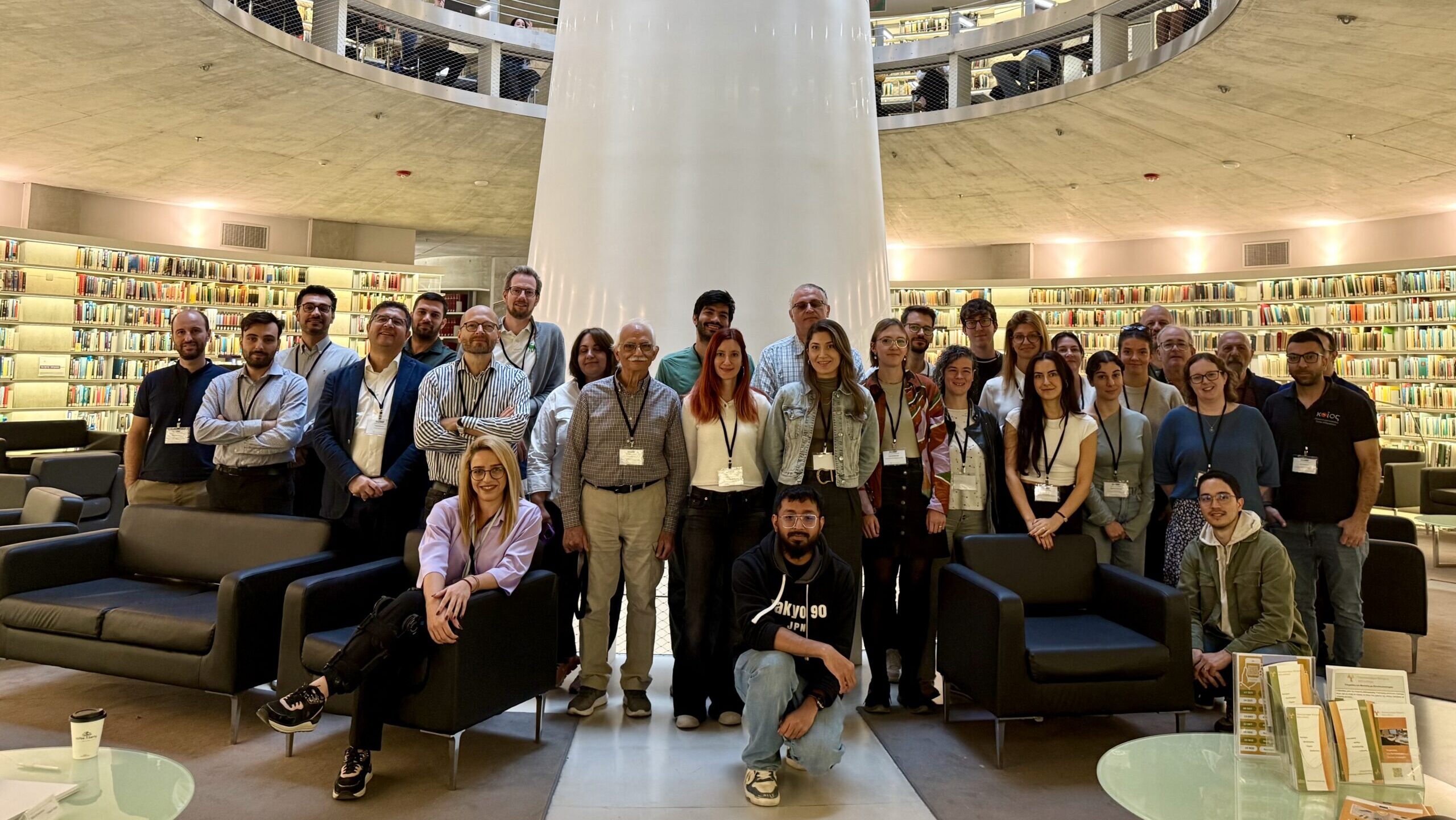
On November 12-13,2025, the intoDBP consortium successfully concluded its 7th General Assembly, hosted by the University of Cyprus, bringing together partners from across Europe for two days of meetings, technical visits, and collaborative workshops. As the project enters its final year, the gathering marked an important milestone in advancing research on disinfection by-products (DBPs) under current and future climatic conditions.
The meeting opened with a compelling presentation on Cyprus’ historical and contemporary water management, detailing the island’s dependence on rainfall, the absence of perennial rivers, and the strategic importance of infrastructures such as the Kouris Reservoir, the largest in Cyprus. This context set the stage for discussions on how intoDBP solutions can support water quality resilience in regions facing increasing water scarcity and climate variability.
The morning continued with a comprehensive overview of project progress, including scientific work packages, case study updates, and management sessions. In the afternoon, partners visited the Limassol Drinking Water Treatment Plant, a cornerstone infrastructure operating since 1994. The plant treats up to 40,000 m³/day—with capacity to double its output—through a robust multi-step process including aeration, coagulation, sedimentation, sand filtration, pH adjustment, and post-chlorination.
A highlight of the visit was the on-site MITO3X® pilot plant, which plays a key role in intoDBP’s work on optimising pre-treatment to reduce disinfection by-product formation. Partners had the opportunity to explore real-world data, operational workflows, and technical challenges.
The day ended with a warm networking dinner, strengthening relationships across the consortium.
The second day of the meeting was dedicated to the Department of Mechanical and Manufacturing Engineering (MME) of the University of Cyprus—one of the four Departments in the School of Engineering. The MME Department advances high-level education, cutting-edge research, and technological innovation across mechanical and manufacturing disciplines.
intoDBP partners received a guided tour of MME’s state-of-the-art facilities, where several intoDBP research activities are progressing. Participants also had the chance to appreciate the university’s distinctive architectural character, including the celebrated Stelios Ioannou Learning Resource Center, an acclaimed “earth-work” building designed by Atelier Jean Nouvel.
The program continued with dissemination and management updates, followed by hands-on workshops addressing key aspects of water quality monitoring, DBP risk assessment, and strategies for supporting utilities and policymakers.
The two-day assembly concluded with partners reaffirming their commitment to advancing the project’s scientific impact and supporting European water operators in addressing DBP challenges through innovative tools, field studies, and collaborative learning.
intoDBP will continue its work throughout 2025, delivering solutions that help protect public health, enhance water treatment processes, and support climate-resilient water management across Europe.